Early Indicators of Student Success
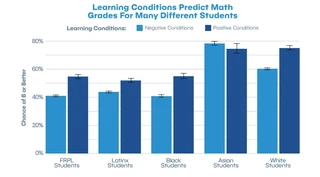
At PERTS, I contributed to research on whether classroom learning conditions could function as early, actionable indicators of later academic outcomes. The question was simple but important: if we can measure whether students feel supported, challenged, and meaningfully engaged in class, can that help educators respond before end-of-term outcomes make problems obvious?
Figure note: Chance of earning a B or better by student group under negative (<5) versus positive (>=5) learning conditions on a seven-point composite scale, including race and reduced-price lunch status.
Highlights
- Learning conditions are early indicators, not just “soft” context.
- Better classroom conditions are strongly associated with better math outcomes.
- This supports practical, repeated measurement so educators can intervene sooner.
Problem
Schools often rely on lagging indicators such as final grades or end-of-year test scores. Those measures matter, but they arrive late. Educators need earlier signals that point to whether students are experiencing the kinds of classroom conditions that support learning.
This project focused on three conditions in math classrooms:
- Teacher Caring
- Meaningful Work
- Feedback for Growth
Approach
We analyzed whether these learning conditions predicted later math performance and whether changes in those conditions over time were associated with changes in student outcomes. The broader goal was to support a continuous-improvement approach in which educators could measure conditions, respond, and reassess rather than waiting for outcomes after the fact.
Methods
The report draws on data collected with the Character Lab Research Network from more than 4,000 U.S. students in grades 8 through 12 during the 2019-20 school year. Students rated learning conditions on a seven-point Likert scale, and those measures were linked to math grades over time.
Analyses examined:
- the relationship between learning-condition ratings and the likelihood of earning a B or better in math
- whether the same relationships held when controlling for demographics and prior grades
- whether changes in learning conditions between October and February predicted later changes in achievement
- whether results differed across student groups, including students eligible for Free and Reduced Price Lunch
Outcome / Impact
The findings make a strong case for treating learning conditions as decision-useful signals rather than soft background context.
- Students who rated learning conditions most positively were more than twice as likely to earn a B or better in math.
- Each step up in the composite learning-conditions score was associated with about 6% more students earning A or B grades.
- A positive two-point shift in learning conditions was associated with roughly a 17% higher likelihood of earning a B or better in the following term.
- Positive learning conditions were especially meaningful for students who had been less well served, including students eligible for FRPL and Black students.
What I like most about this work is that it connects careful behavioral measurement to a concrete intervention model. It is not just an explanatory report; it points toward a system educators can actually use to monitor conditions and improve them over time.
Tools
Education research, survey measurement, longitudinal analysis, regression-style modeling, applied behavioral science, research communication.
I’m a data scientist with a PhD in social psychology. My work sits at the intersection of behavioral science, experimentation, and applied analytics, with experience spanning digital health, education research, and product-focused data work.
I’m especially interested in problems where careful measurement changes real decisions: designing experiments, working with longitudinal and behavioral data, building predictive models, and translating technical results into something a product, research, or leadership team can actually use.
Alongside my analytic work, I maintain a studio art practice in encaustic, cold wax, and watercolor.