RSV Vaccine Attitudes in a Digital Health Intervention
 Topic map of SMS reply themes from the RSV intervention.
This case study is based on published work from my time at Lirio on a digital health intervention designed to increase RSV vaccination among adults over 60. Rather than treating outreach as a one-way campaign, the project looked closely at what people actually texted back and used those replies to better understand attitudes, friction points, and behavior-change opportunities.
Highlights
- Analyzed unsolicited SMS replies to understand RSV vaccine attitudes at scale.
- Used structural topic modeling plus expert thematic coding for interpretable insights.
- Findings informed how live intervention messaging could be improved over time.
Problem
When the RSV vaccine was introduced for older adults in the United States in 2023, many of the drivers of uptake were still unknown.
For teams designing outreach interventions, this creates a familiar challenge: how do you improve messaging when beliefs, concerns, and barriers are still emerging in real time?
Rather than relying solely on structured surveys or downstream outcomes, we turned to a more immediate signal: what people actually texted back.
Approach
The intervention was launched with a large community pharmacy chain using SMS precision nudging to encourage vaccination. As patients replied, we accumulated a large, messy, and highly valuable dataset of unsolicited responses.
However, the scale of the data introduced a new constraint: there were far too many replies for behavioral experts to review manually, and insights were needed quickly to inform an active intervention.
My role as the data scientist was to bridge that gap—developing a scalable way to extract structure and meaning from free-text responses, while preserving the nuance required for behavioral interpretation.
Methods
The study population included 2,481,987 eligible adults aged 60 and older, of whom 35,716 people replied, generating 105,848 text responses. After removing operational texts such as STOP and HELP, the analytic dataset included 46,964 unsolicited replies.
We used a mixed-methods workflow that combined computational modeling with expert interpretation:
- Structural topic modeling (STM) to identify latent themes across the full dataset
- Thematic analysis on a hand-coded subset, conducted by behavioral health experts
- Alignment of model-derived topics with expert-reviewed themes to ensure interpretability
- Characterization of topics along dimensions such as sentiment and practical vs. emotional function
- Comparisons across time, message condition, and available covariates (e.g., flu vaccination history, insurance type)
This approach allowed us to scale insight generation without losing the behavioral context needed for intervention design.
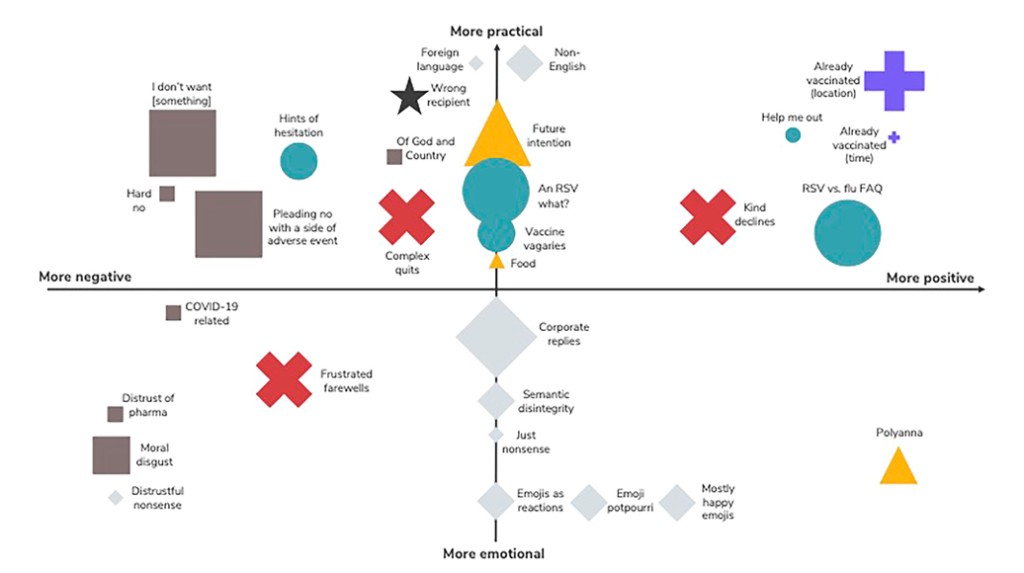
Topic Map of 30 topics in text message replies to a precision nudging digital health intervention for RSV vaccination. Shape and colour indicate the mapping of structural topic model topics onto the 10 thematic analysis topics. Black star = Wrong recipient, teal circle = Help, red cross = Stop, purple plus = Already vaccinated, brown square = Will not get vaccinated, yellow triangle = Benign, and grey diamond = Nonsense. Size indicates topic proportions. Topics 1-10 are largest, topics 11-20 are of middle size, and topics 21-30 are smallest.
Outcome / Impact
The mixed-method approach of modeling and expert review converged to produce a grounded, interpretable map of how adults responded to a newly introduced vaccine in a real-world setting.
Key findings included:
- expressed attitudes became less negative later in the intervention
- individuals without prior flu vaccination and those with commercial insurance were more likely to express refusal
- messages framed around emotional consequences generated the highest engagement
- messages framed around anticipated regret generated the lowest engagement
Beyond the publication, this project demonstrated a practical pattern: behavioral data generated during live interventions can be rapidly structured and fed back into design decisions.
Instead of treating outreach as static, this approach enables a tighter loop between what people say, how we interpret it, and how interventions evolve.
Tools
Behavioral science, thematic analysis, structural topic modelling, text analysis, digital health experimentation, intervention evaluation.
I’m a data scientist with a PhD in social psychology. My work sits at the intersection of behavioral science, experimentation, and applied analytics, with experience spanning digital health, education research, and product-focused data work.
I’m especially interested in problems where careful measurement changes real decisions: designing experiments, working with longitudinal and behavioral data, building predictive models, and translating technical results into something a product, research, or leadership team can actually use.
Alongside my analytic work, I maintain a studio art practice in encaustic, cold wax, and watercolor.